
AD810
AD810 is Low Power Video Op Amp manufactured by Analog Devices.
Data Sheet
Low Power Video Op Amp with Disable AD810
Features
High speed 80 MHz typical
- 3 d B bandwidth (G = +1) 75 MHz typical
- 3 d B bandwidth (G = +2) 1000 V/µs typical slew rate 50 ns typical settling time to 0.1% (VOUT = 10 V step)
Ideal for video applications 30 MHz typical 0.1 d B bandwidth (G = +2, VS = ±15 V) 0.02% typical differential gain (VS = ±15 V) 0.04° typical differential phase (VS = ±15 V)
Low noise 2.9 n V/√Hz typical input voltage noise 13 p A/√Hz typical inverting input current noise
Low power 8.0 m A maximum supply current (quiescent) 2.1 m A typical supply current (power-down mode)
High performance disable function Turn off time: 100 ns typical Break before make guaranteed Input to output isolation of 64 d B (off state)
Flexible operation Specified for ±5 V and ±15 V operation ±2.9 V typical output swing into a 150 Ω load (VS = ±5 V)
APPLICATIONS
Professional video cameras Multimedia systems NTSC-, PAL-, and SECAM-patible systems Video line drivers ADC or DAC buffers DC restoration circuits
GENERAL DESCRIPTION
The AD810 is a posite and HDTV-patible, current feedback, video operational amplifier, ideal for use in systems such as multimedia, digital tape recorders, and video cameras. The 0.1 d B flatness specification at a bandwidth of 30 MHz (G = +2) and the differential gain and phase of 0.02% and 0.04° (NTSC) make the AD810 ideal for any broadcast quality video system. All these specifications are under load conditions of 150 Ω (one 75 Ω back terminated cable).
The AD810 is ideal for power sensitive applications such as video cameras, offering a low power supply current of 8.0 m A
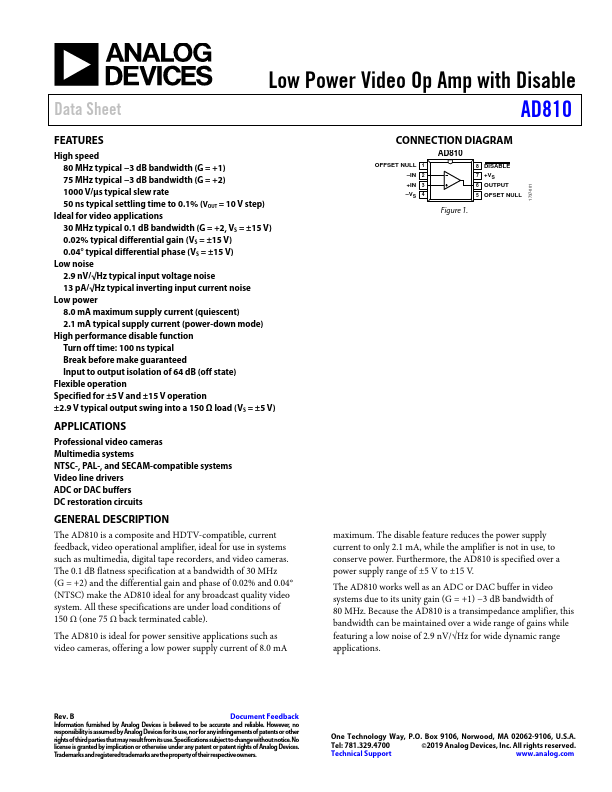
CONNECTION DIAGRAM
OFFSET NULL 1
- IN 2 +IN 3
- VS 4
8 DISABLE 7 +VS 6 OUTPUT 5 OFSET NULL
Figure 1.
1737-001 maximum. The disable feature reduces the power supply current to only 2.1 m A, while the amplifier is not in use, to conserve power. Furthermore, the AD810 is specified over a power supply range of ±5 V to ±15 V.
The AD810 works well as an ADC...