

Datasheet4U Logo Datasheet4U.com

MTV4030-02 - Varactor Diodes

Download the MTV4030-02 datasheet PDF. This datasheet also covers the MTV4030-01 variant, as both devices belong to the same varactor diodes family and are provided as variant models within a single manufacturer datasheet.

Description

The Aeroflex / Metelics MTV4030 Series Tuning Varactors are silicon abrupt junction devices.

They offer the highest Q and lowest resistance available in 30 volt tuning devices.

Features

  • Low Series Resistance.
  • High Q.
  • Extensive Selection of Capacitance Values Maximum Ratings Rating Operating Temperature Storage Temperature Device Dissipation ESD & MSL Ratings Limits Units -55 to +150 °C -65 to +200 °C 250 mW Class 0 (Human Body Model) & MSL1.

📥 Download Datasheet

Note: The manufacturer provides a single datasheet file (MTV4030-01-Aeroflex.pdf) that lists specifications for multiple related part numbers.

Datasheet Details

Part number MTV4030-02
Manufacturer Aeroflex
File Size 147.42 KB
Description Varactor Diodes
Datasheet download datasheet MTV4030-02 Datasheet

Full PDF Text Transcription (Reference)

The following content is an automatically extracted verbatim text from the original manufacturer datasheet and is provided for reference purposes only.

View original datasheet text
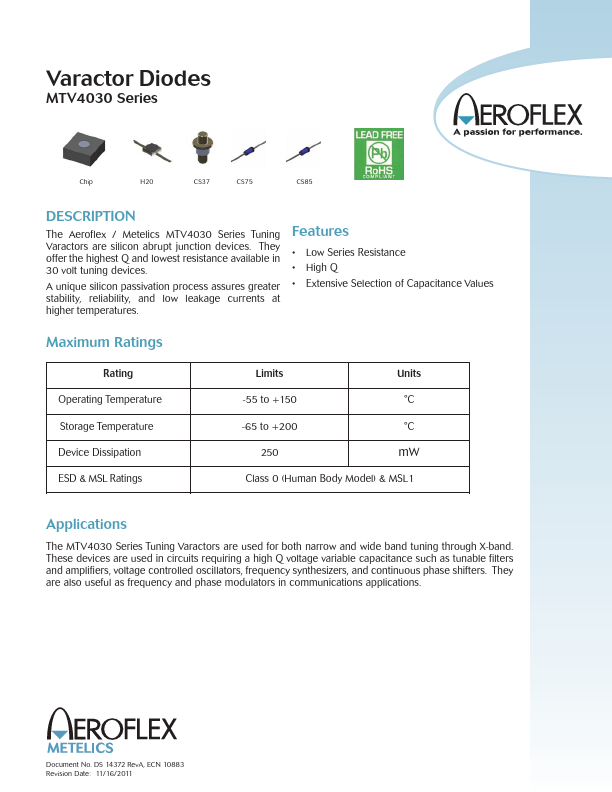
Varactor Diodes MTV4030 Series Chip H20 CS37 CS75 CS85 DESCRIPTION The Aeroflex / Metelics MTV4030 Series Tuning Varactors are silicon abrupt junction devices. They offer the highest Q and lowest resistance available in 30 volt tuning devices. A unique silicon passivation process assures greater stability, reliability, and low leakage currents at higher temperatures. Features • Low Series Resistance • High Q • Extensive Selection of Capacitance Values Maximum Ratings Rating Operating Temperature Storage Temperature Device Dissipation ESD & MSL Ratings Limits Units -55 to +150 °C -65 to +200 °C 250 mW Class 0 (Human Body Model) & MSL1 Applications The MTV4030 Series Tuning Varactors are used for both narrow and wide band tuning through X-band.
Published: |