
MGA-43328
MGA-43328 is 29dBm High Linearity Wireless Data Power Amplifier manufactured by Avago Technologies.
Description
Avago Technologies’ MGA-43328 is a power amplifier for use in the (2.5-2.7)GHz band. High linear output power at 5V is achieved through the use of Avago Technologies’ proprietary 0.25um Ga As Enhancement-mode p HEMT process. It is housed in a miniature 5.0mm x 5.0mm x 0.85mm 28-lead QFN package. It also includes shutdown and switchable gain functions. A detector is also included on-chip. The pact footprint coupled with high gain and high efficiency make the MGA-43328 an ideal choice as a power amplifier for IEEE 802.16 (Wi MAX) and WLL applications.
Features
- High gain: 37.3d B
- High linearity performance: 29.3d Bm at 5V supply (2.5% EVM, 64-QAM ¾ FEC rate OFDMA, 10MHz bandwidth)
- High efficiency: 16.6%
- Built-in detector and shutdown switches
- Switchable gain: 24.5d B attenuation using one single CMOS patible switch pin
- ETSI spectral mask pliant at 29d Bm output power
- Ga As E-p HEMT Technology[1]
- Low cost small package size: 5.0 x 5.0 x 0.85 mm3
- MSL-2a and lead-free
- Usable at 3.3V supply for lower supply voltage applications ponent Image
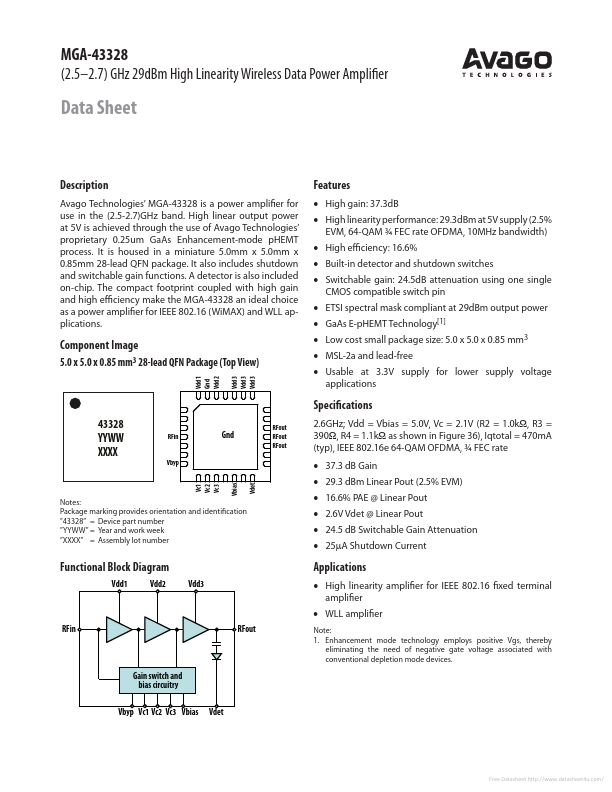
5.0 x 5.0 x 0.85 mm3 28-lead QFN Package (Top View)
Vdd1 Gnd Vdd2 Vdd3 Vdd3 Vdd3
Specifications 43328 YYWW XXXX
RFin
Gnd
RFout RFout RFout
2.6GHz; Vdd = Vbias = 5.0V, Vc = 2.1V (R2 = 1.0k, R3 = 390, R4 = 1.1k as shown in Figure 36), Iqtotal = 470m A (typ), IEEE 802.16e 64-QAM OFDMA, ¾ FEC rate
- 37.3 d B Gain
- 29.3 d Bm Linear Pout (2.5% EVM)
- 16.6% PAE @ Linear Pout
- 2.6V Vdet @ Linear Pout
- 24.5 d B Switchable Gain Attenuation
- 25A Shutdown Current
Vbyp Vbias Vdet Vc1 Vc2 Vc3
Notes: Package marking provides orientation and identification ”43328” = Device part number ”YYWW” = Year and work week ”XXXX” = Assembly lot number
Functional Block Diagram
Vdd1 Vdd2 Vdd3
Applications
- High linearity amplifier for IEEE 802.16 fixed terminal amplifier
- WLL amplifier
RFout
Note: 1. Enhancement mode technology employs positive Vgs, thereby eliminating the need of negative gate voltage...